

Why is it so hard to plan your life for success? It’s because you need to start at the right place.
The problem isn’t that people don’t know they should plan. Most people have tried. They’ve written goals on January 1st, followed their plan for two weeks and then… Nothing. Still feeling stuck. Still wondering if this is really it.
Here’s the real issue: most life plans are built on the wrong foundation.
They focus on how to plan your life for success before asking what to plan for — and more importantly, why. Without that foundation, even the best system falls apart.
This article is different. It starts where every good plan should start: with you — your values, your definition of success, and an honest look at what’s been getting in your way.
Why Most Life Plans Fail Before They Start
Think about the last time you set a goal and didn’t follow through. Was it because you were lazy? Probably not. Most people who feel stuck in life are not lazy.
So what happened?
The answer is almost always misalignment. The goal didn’t connect to anything deep enough to sustain effort when things got hard. And things always get hard.
Research backs this up. When goals reflect your personal values — rather than external pressure or social comparison — you’re far more likely to stick with them and actually feel better when you achieve them. (Sheldon & Elliot, 1999)
This is why “make more money” works as a goal for one person and burns out another. On the surface, they look the same. Underneath, they’re completely different people with completely different motivations.
Before you plan your life for success, you need to know who you’re building it for.
“Failing to plan is planning to fail.”
Plan Your Life for Success. Step 1: Know Your Values
The Schwartz Theory of Basic Human Values
In the early 1990s, psychologist Shalom Schwartz set out to answer a question: are there values that every human being shares, regardless of culture or background?
The answer was yes — with a catch.
Schwartz identified 10 universal values that appear across cultures worldwide. But here’s the thing: we don’t all rank them the same way. What matters most to you shapes everything — how you make decisions, what kind of work feels meaningful, and what success actually looks like for you.
The 10 values are organised around two key tensions:
- Openness to Change (Self-Direction, Stimulation) vs. Conservation (Security, Conformity, Tradition)
- Self-Enhancement (Power, Achievement, Hedonism) vs. Self-Transcendence (Universalism, Benevolence)
No value is better than another. But some values conflict. If you score high on Power and high on Benevolence, for example, you’re likely to feel torn a lot — because those two values pull in opposite directions. That tension may be exactly why you’ve felt stuck.
→ Learn more about Schwartz’s Theory of Basic Human Values on Wikipedia
Try this: Look at the 10 values below and pick your top 4 or 5 — the ones that feel most like you, not the ones you think you should choose.
| Value | What it means |
|---|---|
| Self-Direction | Freedom to think and act independently |
| Stimulation | Novelty, excitement, challenge |
| Hedonism | Pleasure and personal enjoyment |
| Achievement | Personal success through demonstrated competence |
| Power | Status, prestige, control over resources |
| Security | Safety, stability, and order |
| Conformity | Restraint and respect for social norms |
| Tradition | Respect for culture, religion, and custom |
| Benevolence | Care for the welfare of close others |
| Universalism | Understanding and care for all people and nature |
Now look at your top values. Are any of them in tension with each other? That tension is data. It tells you where your inner conflict comes from – and where your plan needs to be especially honest.
To plan your life for success – you must build it around yourself.
Plan Your Life for Success. Step 2: Define What Success Actually Means to You
This is the most skipped step in any self-help article. It’s also the most important.
Most people absorb their definition of success from the world around them. From parents who pushed security. From friends who celebrated money and gold chains.
So they chase that — and arrive somewhere that doesn’t feel like home.
Success is not a universal destination. It’s a personal alignment between your values and your life.
To make this concrete, think about three core domains:
- Money – financial freedom, security, generosity, or abundance?
- Health – energy, longevity, strength, or adventure?
- Relationships – depth, family, community, or intimacy?
Now layer your Schwartz values onto each one when you plan your life for success.
Take two people, both of whom say they want “financial success.” James scores high on Benevolence. For him, financial success means having enough to give generously and provide for his family. He doesn’t care much about status. Sara scores high on Power and Achievement. For her, financial success means building something visible — a business, a portfolio, a reputation. Neither is wrong. But if James spent his career chasing Sara’s definition of success, he’d feel hollow even on his best days.
Write a success statement for each domain. Make it specific, personal, and grounded in your top values. This becomes the north star that everything else orbits.
Plan Your Life for Success. Step 3: Map Flourishing With the PERMA Framework
Once you know what success looks like for you, you can plan your life for success.
However, to give you a better picture of how it will look like on the daily basis, you need a framework. What is a good life? How will you feel on your way to your goals?
Will you hate your life? Will you suffer and rely on your temporary willpower?
This is where PERMA comes in.
Developed by psychologist Martin Seligman, PERMA is a model of wellbeing that describes what a flourishing life actually consists of. It’s not about happiness alone — it’s about the full picture of human thriving. (Butler & Kern, 2016)
The five pillars are:
- P — Positive Emotions: Do you feel joy, gratitude, or hope on a regular basis?
- E — Engagement: Are you absorbed in what you do? Do you experience flow?
- R — Relationships: Do you have meaningful, supportive connections in your life?
- M — Meaning: Do you feel connected to something larger than yourself?
- A — Accomplishment: Are you progressing, growing, and achieving things that matter to you?
→ Learn more about PERMA and positive psychology on Wikipedia
PERMA gives your values a real-world shape and helps you better plan your life for success. It answers the question: what does a values-aligned life actually feel like, day to day?
Do a quick audit. Rate yourself from 1 to 10 on each pillar – right now, not as you wish things were. Be honest. How satisfied are you with this pillar?
Next, assess how important it is for you.
Where are you lowest among the important things in life? That’s often where the most important work begins.
And notice how your Schwartz values show up in each pillar. Meaning looks different for someone high in Universalism (contributing to society) than for someone high in Tradition (honouring family and heritage). There is no single right answer. There’s only your answer.
Plan Your Life for Success. Step 4: Set Process Goals, Not Outcome Goals
Here’s where most advice on how to plan your life for success goes wrong. People set outcome goals — and then wonder why they lose motivation.
An outcome goal is something like: “I want to lose 10 kilograms.” Or: “I want to earn £80,000 a year.” These sound clear. But they have a fatal flaw: you can’t control them directly. You can do everything right and still fall short, through no fault of your own. When that happens, the goal punishes you instead of guiding you.
A process goal is different. It focuses on what you actually do — not what you hope to achieve.
- “I want to lose 10 kilograms” becomes “I will exercise four times a week.”
- “I want to earn £80,000” becomes “I will reach out to five potential clients every week.”
You can always win a process goal. It’s fully in your control. And that’s exactly what keeps you going when motivation dips — which it will.
Process goals are also how PERMA gets built in real life. Engagement and Accomplishment don’t come from reaching a destination. They come from showing up. Consistently. Over time.
Here’s a useful exercise: take your lowest PERMA pillar and ask yourself — what would I do differently, every week, if I were serious about improving this? That action becomes your process goal.
A word of caution: don’t set five process goals at once. Pick two or three maximum. Doing fewer things better beats doing many things badly every time.
Plan Your Life for Success Step 5: Stress-Test Your Plan With the MIST Framework
You have your values, your success statements, and your process goals. Now, before you launch — stop.
Most people fail not because they lack discipline or commitment. They fail because they start without what they actually need to succeed.
The MIST Framework is a simple way to pressure-test any goal before you begin. It asks four questions:
- M — Materials: Do you have the physical resources? Money, space, energy?
- I — Information: Do you know how to do this? Or is there a knowledge gap that needs to close first?
- S — Skills: Are you capable of doing this today? Or does a skill need to be built along the way?
- T — Tools: Do you have the equipment, systems, apps, or support structures you need?
Let’s make this real. Say your lowest PERMA pillar is Engagement, and your process goal is to spend one hour a day working on a creative project.
Run it through MIST:
Materials: Do you have the time to make it work, every day? The energy? The money to afford the things you’ll need?
Information: Do you know what the project actually involves? (Maybe you need to research first.)
Skills: Do you have the core skill, or do you need to learn something beforehand?
Tools: Do you have the software, the pens and brushes?
A missing MIST element is an action item. The thing you need to do first isn’t the goal itself. Or, you can change the goal to better match what MIST items you have available right now.
This single step prevents months of stalled momentum.
Step 6: Plan for Failure — Before It Happens
This is the part most people skip. And it’s probably the most valuable part of this entire article.
Planning for failure is not pessimism. It’s engineering.
Think about it this way: not failing is more important than doing the right thing. A plan that keeps you in the game — even imperfectly — beats a perfect plan that you abandon after three weeks.
Start with your own history. Where have you quit before? When? Under what circumstances? Be specific. Was it when life got busy? When you stopped seeing results? When someone close to you was critical?
Now look at those patterns through the lens of your Schwartz values. Often, the reason we give up isn’t laziness — it’s that a goal stopped feeling like ours. Something shifted. A value was being violated. The goal started to feel like someone else’s idea.
Try the pre-mortem technique. Imagine it’s six months from now and this plan has completely fallen apart. What went wrong? Write it down. Be as specific and honest as you can.
Then build if-then responses for your most likely failure scenarios:
- “If I miss my process goal for three days in a row, then I will…”
- “If I feel like this plan no longer reflects who I am, then I will…”
- “If I get a piece of negative feedback that knocks my confidence, then I will…”
These are resilience triggers — pre-made decisions that mean you don’t have to rely on willpower in a vulnerable moment. The decision is already made. You just follow it.
Step 7: Build Habits and Systems Around Your Values
Goals get you started. Habits keep you going.
But here’s the thing about habits: the ones that don’t connect to your values will eventually be dropped. You’ll find reasons to skip them. They’ll feel like obligations rather than choices.
So when you design your habits, connect them directly to your Schwartz values and your PERMA pillars.
Look for keystone habits — single behaviours that reinforce multiple PERMA pillars at once. These give you the most return for the smallest investment of time and energy.
For example: a weekly dinner with close friends hits Relationships, Positive Emotions, and Meaning all at once. A regular walk in nature — especially if you score high on Universalism — might hit Positive Emotions, Engagement, and Meaning simultaneously.
Design your environment to make these habits easy. Remove friction. Put the running shoes by the door. Block the time in your calendar before anything else fills it.
And choose your accountability structure based on your values, not someone else’s system:
- High Benevolence? An accountability partner will work well. You’ll find it hard to let them down.
- High Self-Direction? A solo review system — a journal, a weekly check-in with yourself — may suit you better than reporting to someone else.
There is no single right way. There’s only what actually works for you.
Step 8: Review, Reflect, and Realign
A plan is not a contract. It’s a living document.
Your values may shift. Your PERMA profile will change. What felt like the right definition of success at 32 may look quite different at 38. That’s not failure — that’s growth.
Build a regular review practice, and tie it to writing. Journaling is one of the most powerful tools for self-discovery available to you. There is something about putting words on a page — even messy, unfinished words — that helps you see clearly.
Here’s a simple cadence to follow:
- Weekly: Did I hit my process goals? What got in the way?
- Monthly: Are my MIST gaps closing? What do I still need?
- Quarterly: Is my PERMA profile improving? Where am I still low?
- Annually: Does my definition of success still reflect my values? What needs to change?
Also — reward yourself. Not with grand gestures, but with small, meaningful acknowledgements of progress. Research on behaviour change consistently shows that small, immediate rewards are more effective than big, distant ones. They close the loop between action and satisfaction, which keeps the system running.
Don’t wait to celebrate until you reach the outcome. Celebrate showing up.
Conclusion: Success Is Alignment, Not Achievement
Here’s the reframe that ties everything together.
Success is not a finish line. It’s not a number in your bank account or a title on your LinkedIn profile. It’s a life that keeps reflecting who you actually are — your values, your strengths, and what genuinely matters to you.
That’s harder to measure. But it’s far more durable.
The system this article has outlined is not a quick fix. It’s a framework that respects your complexity and asks you to do the honest work of understanding yourself before building anything.
Here’s the short version:
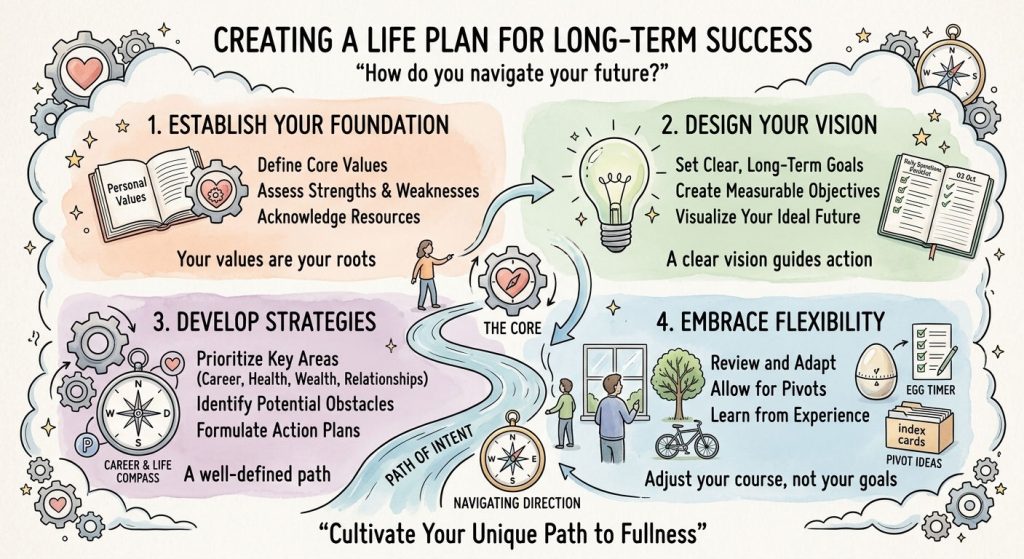
Know your values (Schwartz) → Define your success → Map flourishing (PERMA) → Set process goals → Stress-test with MIST → Plan for failure → Build habits that fit → Review and realign.
You don’t need to do all of this today. But you do need to start somewhere.
Start with the values exercise. That single step will make everything that follows more honest, more personal, and more likely to last.
Want to understand yourself better before you build your plan? Explore your personality profile at Personal Discovery Map — it’s a good place to start.
Leave a Reply
You must be logged in to post a comment.